The short, visual version of the series. The long reads are The Quiet Joining-Up, Statistics or Operations?, and Ruled Unlawful Next Door. This one is just: here is the machine, in one picture.
In one line
Splink takes records that were never meant to be joinable — your health, tax, justice, benefits and census records, sitting in separate systems with no shared ID number — and matches them, probabilistically, into one linked profile of you. It is free, open-source, and built by the UK Ministry of Justice.
No hack
This is the part that matters most, and it is why the story is credible rather than hysterical. Nothing here is a breach, a leak, or a hack. The maths (the Fellegi–Sunter model) is mainstream and the published accuracy is high. The data is handled by vetted researchers in controlled settings, usually de-identified. The concern is not that the tool is broken. The concern is what an accurate, working version of it quietly makes possible.
No consent
There is no consent step because, in law, none is required. Population-scale administrative linkage runs on a statutory “public task” basis (in the UK, powers like the Digital Economy Act 2017), which does not ask the individual for permission. So this is not a claim that anyone broke the rules — the rules were written to permit it. The honest, uncomfortable point is narrower: the legal basis is one most people have never heard of, and you were never asked.
No opt-out
And because the basis is public task rather than consent, there is, as a rule, no individual notification and no right to object. You are not told your health, tax, justice and benefits records were stitched into one profile, and in most cases there is no mechanism to say no.
The same thing, drawn as a flow — separate inputs in, one profile out:
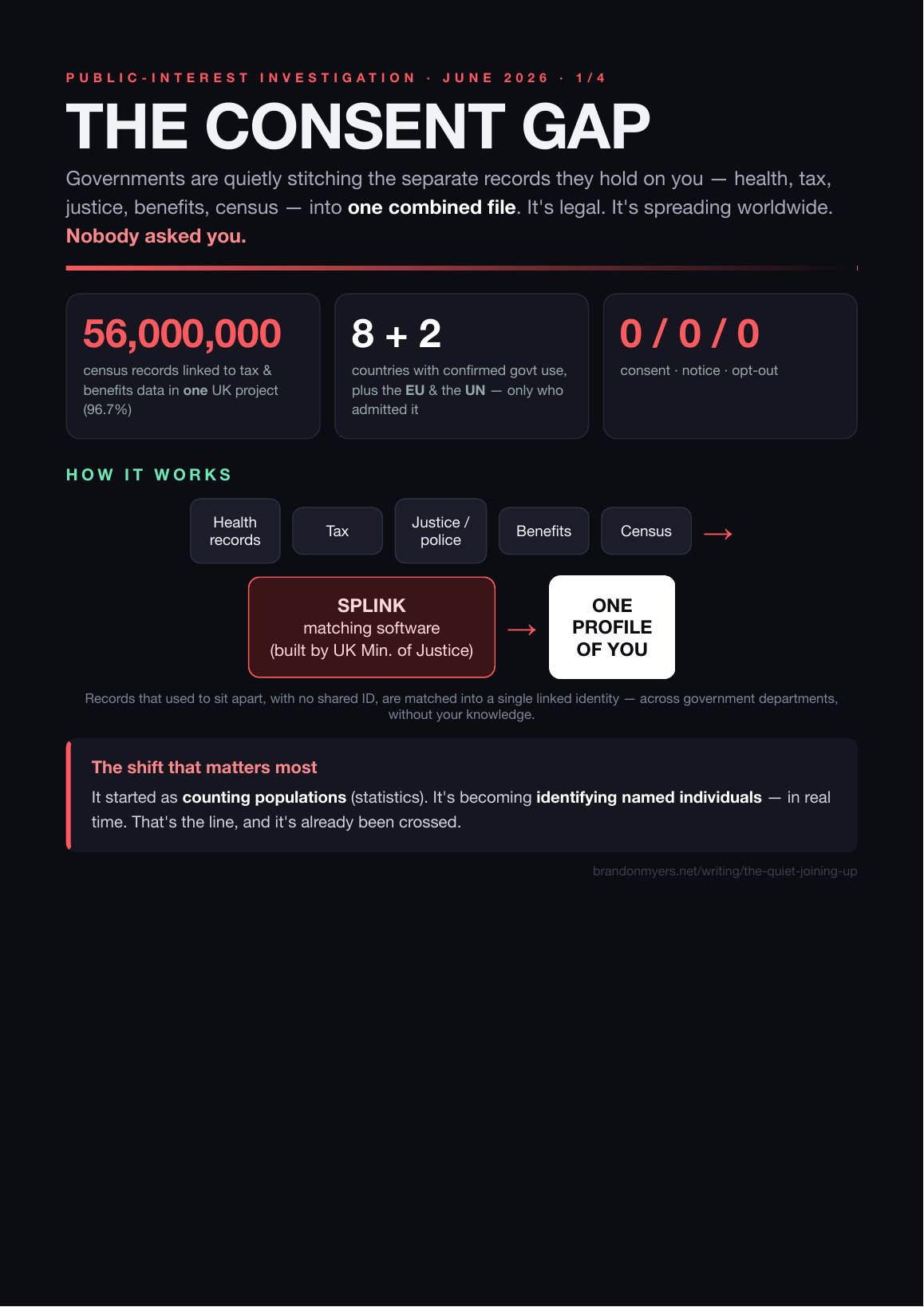
The shift that should worry you
It started as a way of counting populations — statistics, research, de-identified, retrospective. The government’s own transparency records now describe the same tool running in courts, in real time, and being piloted to assign a single cross-justice identifier to named individuals. That is the move from statistics to operations — from counting people to identifying a specific person — and it is the line the series tracks. The full evidence, every claim sourced to the government’s own documents, is in Statistics or Operations?
And the courts?
No court has ruled Splink, Data First, ONS IDS or ADR UK unlawful — and I say so plainly. But the same shortcut this machinery leans on, keeping data-protection safeguards in policy instead of law, has been struck down by the courts three times in the adjacent immigration regime. The full legal map is in Ruled Unlawful Next Door.
Graphic built from the government’s own published documents — GOV.UK Algorithmic Transparency Records (moj-data-first-splink, moj-splink-master-record), the Splink documentation, and ADR UK. Full sourcing and archived evidence: The Quiet Joining-Up · GitHub repository.